Web Browsers: WPE WebKit and Chrome
Applies to: i.MX STM32MP2
A product that shows its user interface as a web page needs a browser engine on the board. This page compares the two that run on Cargt SOMs, WPE WebKit and Chromium (Chrome), measured by Cargt in November 2026: how much flash and RAM each adds, how fast each renders on each SoC, and how to build them.
Summary
Flash: WPE WebKit adds 163 to 174 MB to the image, and a trimmed build 130.5 MB. Chrome adds 382 to 385 MB. WPE WebKit saves 210 to 250 MB per image.
Build time: WPE WebKit compiled in 40 to 63 minutes on Cargt’s build host; Chromium took 3.6 to 4.5 hours.
RAM: with 1 GB of RAM (emulated, see Caveats), both browsers ran every test page without running out of memory and at unchanged frame rates.
i.MX 95 and i.MX 8M Plus: both browsers reach 60 frames per second on animation the GPU can composite. Chrome is much faster on pages that repaint every frame, and on WebGL on the 8M Plus. WPE WebKit uses less CPU on composited animation.
STM32MP2: WPE WebKit only; Chromium is not supported on it. Composited animation runs at the panel’s refresh rate, and WebGL at 26 frames per second.
i.MX 93 (no 3D GPU): either browser handles static pages. Animation that only moves or fades elements runs at 52 frames per second with WPE WebKit and 19 with Chrome, with both CPU cores busy. Pages that repaint every frame are not usable: Chrome manages 8 frames per second and WPE WebKit less than 1. Neither browser can use WebGL. Without a GPU, WPE WebKit draws it on the CPU at about 3 frames per second, and Chrome turns WebGL off (forcing it on gives 5 frames per second).
Which Browser for Which SoC
SoC |
Recommendation |
|---|---|
STM32MP2 |
WPE WebKit, the only engine that runs. It fits in 1 GB of RAM.
Use the trimmed build (130.5 MB) where the root file system slot is
tight: on the test board, a 3 GB slot with the development image
had 190 MB free. Run |
i.MX 93 |
WPE WebKit or Chrome, for mostly static pages: dashboards with text
and number updates. 1 GB is enough. Prefer WPE WebKit when flash
matters and the page animates only with |
i.MX 8M Plus and i.MX 95 |
Either. WPE WebKit for products where flash, RAM or build time matter; Chrome for heavy web applications with a lot of repainting or WebGL. |
The least expensive platform that runs a browser adequately is the STM32MP2 with 1 GB and WPE WebKit. The least expensive SoC on which Chrome performs well is the i.MX 8M Plus.
At a Glance
The charts show the main results; the tables under Results have every number. WPE WebKit is green, its trimmed build light green, and Chrome orange. Chrome does not run on the STM32MP2, and its panel refreshes at 44 Hz rather than 60.
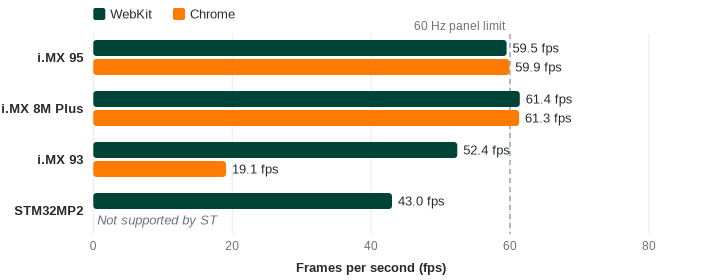
Animation the GPU can composite (the csst page). Both browsers reach the
panel’s rate on the i.MX 95 and 8M Plus; on the i.MX 93, WPE WebKit is
almost three times faster.
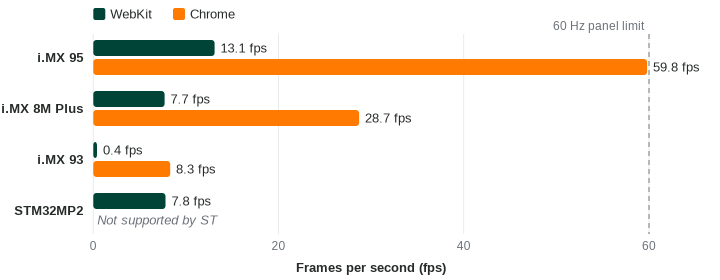
A page that lays out and repaints every frame (the css page). Chrome is
much faster on every SoC it runs on.
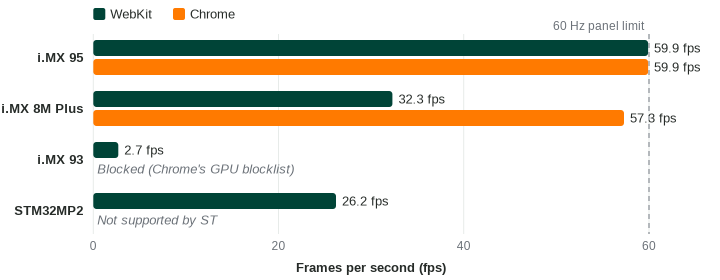
A full-screen WebGL shader. On the i.MX 93, which has no 3D GPU, Chrome turns WebGL off.
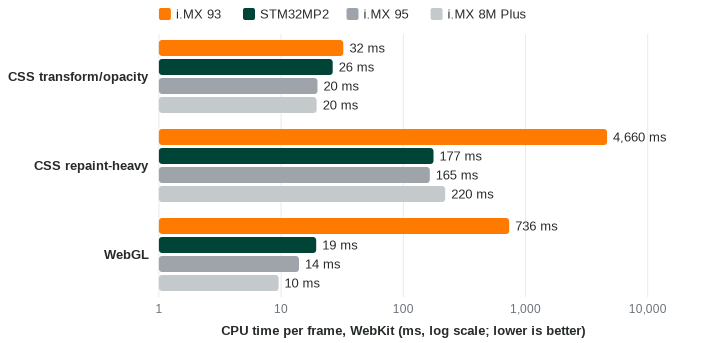
WPE WebKit’s CPU time per frame (CPU load times cores, divided by the frame rate; log scale). The STM32MP2’s GPU keeps it close to the i.MX 95 and 8M Plus; without a GPU, the i.MX 93 needs more than 20 times the CPU per frame on repaint-heavy pages.
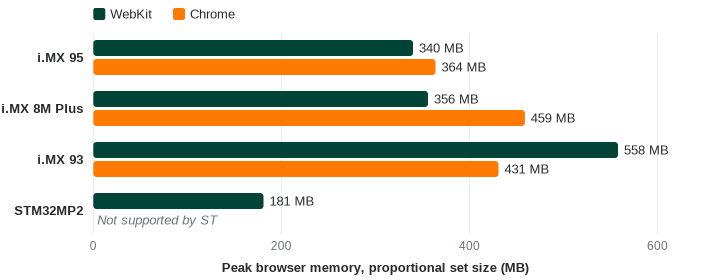
The most memory the browser used on any test page (proportional set size of all its processes).
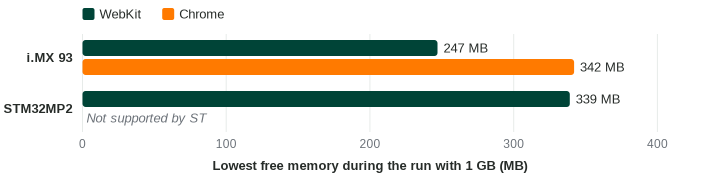
The lowest available memory during the runs with 1 GB of RAM (emulated). Every run kept more than 240 MB free.
How It Was Measured
Four synthetic test pages ran on each board, under Weston unless noted:
Page |
Content |
|---|---|
|
Cards and a table, no animation. |
|
The worst case: 60 boxes with shadows animate their |
|
The same boxes, animating |
|
A full-screen WebGL fragment shader. |
fps: a
requestAnimationFramecounter in each page, over 30 s.CPU: the whole system, as a percentage of all cores.
Browser PSS: the proportional memory of all the browser’s processes.
System used: total memory minus the lowest available memory during the 30 s.
Startup: from launch until the page first reports, with a warm cache unless noted.
Results
i.MX 95
i.MX 95 00414 on the 00365 carrier: six Cortex-A55 cores, Mali-G310 GPU, 10.1” LVDS display (1280x800), WPE WebKit 2.52.6, Chromium 142.
Page |
WPE fps |
Chrome fps |
WPE CPU |
Chrome CPU |
WPE PSS |
Chrome PSS |
|---|---|---|---|---|---|---|
static |
– |
– |
3% |
0.8% |
315–324 MB |
329–335 MB |
css |
13.1 |
59.8 |
36% |
36% |
328 MB |
364 MB |
csst |
59.5 |
59.9 |
20% |
30% |
317 MB |
358 MB |
webgl |
59.9 |
59.9 |
14% |
16% |
340 MB |
341 MB |
Startup: WPE WebKit 0.57 s; Chrome 0.9 s warm, 2.6 s cold.
WPE WebKit ran as
MiniBrowseron the WPEPlatform API under Weston;cogon DRM, without Weston, gave the same results.cogunder Weston does not run on this GPU (see Launchers).WebGL reached 60 fps with the GPU’s
performancefrequency governor. The default governor held the GPU at 800 MHz, which gave about 52 fps.Whole-system memory was not measured on this board.
i.MX 8M Plus
i.MX 8M Plus 00377 on the 00365 carrier: four Cortex-A53 cores, GC7000UL GPU, 10.1” LVDS display (1280x800), WPE WebKit 2.52.6, Chromium 142.
Page |
WPE fps |
Chrome fps |
WPE CPU |
Chrome CPU |
System used, WPE / Chrome |
WPE PSS |
Chrome PSS |
|---|---|---|---|---|---|---|---|
static |
– |
– |
0.7% |
1.0% |
666 / 645 MB |
253 MB |
293 MB |
css |
7.7 |
28.7 |
42% |
33% |
654 / 831 MB |
260 MB |
459 MB |
csst |
61.4 |
61.3 |
30% |
52% |
659 / 643 MB |
261 MB |
321 MB |
webgl |
32.3 |
57.3 |
8% |
21% |
768 / 645 MB |
356 MB |
307 MB |
Startup: WPE WebKit 0.61 s warm, 1.91 s cold; Chrome 1.0 s warm, 2.67 s cold.
WPE WebKit ran as
cogunder Weston.WPE WebKit’s WebGL kept the GPU fully busy for 32 fps, against 57 fps for Chrome. Its WebGL path on this GPU is less efficient.
The development image without a browser used about 560 MB.
i.MX 93
i.MX 93 00363 on the 00428 carrier: two Cortex-A55 cores, no 3D GPU (Mesa’s software renderer), MIPI-DSI output (720x1280) with no panel attached, WPE WebKit 2.52.6, Chromium 142.
Page |
WPE fps |
Chrome fps |
WPE CPU |
Chrome CPU |
System used, WPE / Chrome |
WPE PSS |
Chrome PSS |
|---|---|---|---|---|---|---|---|
static |
– |
– |
1% |
3% |
702 / 492 MB |
481 MB |
337–348 MB |
css |
0.4 (24 s to the first frame) |
8.3 |
93% |
87% |
710 / 539 MB |
479 MB |
397 MB |
csst |
52.4 |
19.1 |
85% |
78% |
698 / 569 MB |
483 MB |
431 MB |
webgl |
2.7 |
not available |
99% |
– |
781 / 479 MB |
558 MB |
341 MB |
Startup: WPE WebKit 1.2 s warm, 2.8 s cold; Chrome 1.3 s warm, 3.2 s cold.
WPE WebKit ran as
cogunder Weston.Chrome’s GPU blocklist disables WebGL on Mesa’s software renderer, and Chrome then composites in software too.
--ignore-gpu-blocklistforces WebGL on, at 5.0 fps with 98% CPU.The DSI output kept running and pacing frames without a panel, so the frame rates, CPU and memory are representative; the picture itself was not checked.
The development image with Weston and no browser used about 390 MB.
With 1 GB of RAM (emulated, about 546 MB available before the browser started):
Page |
WPE fps |
Chrome fps |
WPE lowest available |
Chrome lowest available |
|---|---|---|---|---|
static |
– |
– |
400 MB |
418 MB |
csst |
51.0 |
19.5 |
329 MB |
342 MB |
css |
0.4 |
8.3 |
307 MB |
371 MB |
webgl |
2.7 |
– |
247 MB |
– |
Nothing ran out of memory and the frame rates did not change. Startup was 1.5 s for WPE WebKit and 2.6 s for Chrome. On the i.MX 93 the limit is the CPU, not the memory.
STM32MP2
STM32MP257F 00395-01 on the 00365 carrier: two Cortex-A35 cores, GC8000UL GPU, 5.5” MIPI-DSI display (720x1280) refreshing at 44 Hz, WPE WebKit 2.54.2, default and trimmed builds (see Building WPE WebKit).
Page |
Default fps |
Trimmed fps |
CPU |
System used (trimmed) |
PSS (trimmed) |
|---|---|---|---|---|---|
static |
– |
– |
3–4% |
400 MB |
165–168 MB |
css |
7.6 |
7.8 |
68–69% |
416 MB |
167 MB |
csst |
43 (the panel’s rate) |
43 |
56–57% |
407 MB |
173 MB |
webgl |
26.3 (limited by the GPU) |
26.2 |
22–25% |
458 MB |
181 MB |
Startup: default 0.84 s warm, 2.85 s cold; trimmed 0.70 s warm, 2.57 s cold.
WPE WebKit ran as
cogunder Weston.The development image without a browser used about 320 MB.
With 1 GB of RAM (emulated, trimmed build, about 426 MB available before the browser started):
Page |
fps |
Lowest available |
PSS |
|---|---|---|---|
static |
– |
382 MB |
135 MB |
csst |
43.0 |
380 MB |
138 MB |
css |
7.8 |
371 MB |
139 MB |
webgl |
25.5 |
339 MB |
155 MB |
Nothing ran out of memory, the frame rates did not change, and startup was 1.07 s.
Image Size
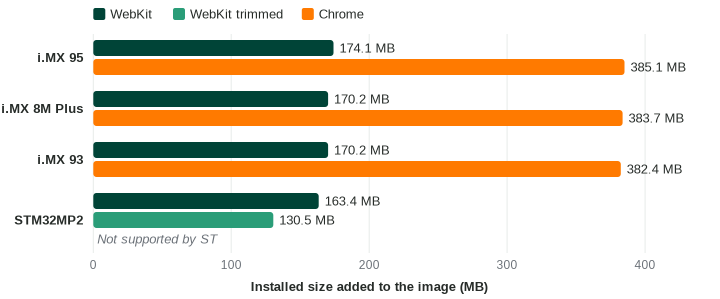
Installed size each browser adds to cargt-image-dev.
Installed size added to cargt-image-dev:
SoC |
WPE WebKit |
Trimmed WPE WebKit |
Chrome 142 |
|---|---|---|---|
i.MX 95 |
174 MB (with |
– |
385 MB |
i.MX 8M Plus |
170 MB |
– |
384 MB |
i.MX 93 |
170 MB |
– |
382 MB |
STM32MP2 |
163 MB |
130.5 MB |
not supported |
WPE WebKit: the engine library is 119 to 121 MB. The rest is speech synthesis (
flite, 27 MB), fonts (6 to 11 MB), JPEG XL (3.5 MB), the web inspector (1.4 MB) andcog(0.5 MB). The trimmed build saves space mostly by leaving out speech synthesis, JPEG XL and the inspector; thereduce-sizecompile option saved only 2 MB.Chrome:
chromium-ozone-waylandis 365 to 367 MB, plus GTK 3 (13.7 MB), which Chrome did not need to run.On the i.MX 95, the compressed root file system tarball grew from 449 MB to 510 MB with WPE WebKit.
Building WPE WebKit

Compile time on Cargt’s build host, longest run of each.
WPE WebKit comes from Igalia’s meta-webkit layer. Add it to
bblayers.conf, then add to local.conf:
PREFERRED_PROVIDER_virtual/wpebackend = "wpebackend-fdo"
IMAGE_INSTALL:append:pn-cargt-image-dev = " wpewebkit cog"
i.MX (wrynose): use meta-webkit’s wrynose branch (WPE WebKit
2.52.6; wrynose-latest has 2.54.2). Two more lines:
# NXP's mali-imx recipe doesn't register libgles2 as provided, so
# wpewebkit's dependency on it fails to resolve. Harmless on the other GPUs.
RDEPENDS:wpewebkit:remove:pn-wpewebkit = "libgles2"
# i.MX 95 under Weston: add the WPEPlatform API and MiniBrowser
PACKAGECONFIG:append:pn-wpewebkit = " wpe-platform minibrowser"
The libgles2 line works around a bug in NXP’s mali-imx.inc: it
builds its RPROVIDES keys in an anonymous Python function, where they
are never expanded, so nothing can depend on libgles2. bitbake -e
hides the problem because it expands the keys when it prints them.
STM32MP2 (scarthgap): use meta-webkit’s scarthgap-latest branch
(WPE WebKit 2.54.2); the plain scarthgap branch stops at 2.46.7. No
libgles2 workaround is needed. For the trimmed build:
PACKAGECONFIG:remove:pn-wpewebkit = "accessibility avif gamepad jpegxl libbacktrace mediastream remote-inspector speech-synthesis spellcheck sysprof"
PACKAGECONFIG:append:pn-wpewebkit = " reduce-size"
# meta-webkit 2.54: video needs GStreamer's mpegts library, which the
# recipe only adds with mediastream. Without this, do_configure fails.
DEPENDS:append:pn-wpewebkit = " gstreamer1.0-plugins-bad"
The trimmed build keeps the JIT, video, Media Source, Web Audio, WOFF2 fonts, WebDriver and the GPU process.
Chrome
Chrome is chromium-ozone-wayland from the meta-browser layer; the results above
are Chromium 142.0.7444.175, from the wrynose branch. ST does not support
Chromium on the STM32MP2.
To render with the GPU, start Chromium 142 with:
chromium --ozone-platform=wayland --use-gl=angle --use-angle=gles <url>
Chromium 142 rejects --use-gl=egl and falls back to software
rendering. --kiosk gives a full-screen window without browser controls.
With these flags Chrome rendered with the GPU on the i.MX 95 and 8M Plus;
on the i.MX 95 its WebGL renderer reported ANGLE (ARM, Mali-G310, OpenGL ES
3.2).
Launchers
WPE WebKit has no window of its own; a launcher creates one. cog is the
usual one, and it can draw through Weston (cog -P wl, full screen with
COG_PLATFORM_WL_VIEW_FULLSCREEN=1) or directly on the display without
Weston (cog -P drm). Not every combination works on every GPU:
SoC |
|
|
|---|---|---|
i.MX 95 |
Fails: the Mali driver lacks the EGL function
|
Works |
i.MX 8M Plus |
Works |
Fails: pages load, but frames never reach the display |
i.MX 93 |
Works |
Static pages only; animated pages abort |
STM32MP2 |
Works |
Fails: |
On the i.MX 95 under Weston, build the WPEPlatform API and MiniBrowser
(the PACKAGECONFIG line above, +3 MB) and run
/usr/libexec/wpe-webkit-2.0/MiniBrowser -f <url>. A product would use a
small launcher of its own on the same API.
cog writes the page’s console messages to standard output with
--enable-write-console-messages-to-stdout=true, which helps when
debugging a page on the board. On DRM, cog crashes when it is stopped
with SIGTERM; a product launcher should exit cleanly.
Caveats
Synthetic pages. A real page may perform anywhere between
csstandcss. Test with your own content.Development image. All memory figures are on
cargt-image-dev, which uses 320 to 560 MB before a browser starts. A product image leaves more room.1 GB was emulated. A process locked enough memory on a 2 GB board to leave what a 1 GB SOM would have, assuming the same kernel, CMA and GPU reservations. It was not measured on 1 GB hardware.
Different WPE WebKit versions. 2.52.6 on i.MX, 2.54.2 on STM32MP2.
Displays differ. The i.MX 95 and 8M Plus drove 1280x800 LVDS panels; the i.MX 93 and STM32MP2 a 720x1280 DSI output, with no panel on the i.MX 93 and a 44 Hz panel on the STM32MP2.
BSP state. The i.MX results were built from
meta-imx-cargtas of October 27, 2026.The browsers ran from a separate root file system on each board’s existing image, using the build’s GPU libraries (the board’s own on the STM32MP2).